|
Waste to Fuel - by the Renewable Energy Institute Business Development * Engineering * Project Development * Strategic Marketing
This Ad Space Available Available Through the Renewable Energy Institute
Advertising Your Company, Products or Services on Our Site *
New Customers
For more information, call/email the
______________________________________________________ We
advocate and support greater use of Waste to Fuel, Waste to Energy and Biomass Gasification * Carbon Emissions * Carbon Free Energy * CHP Systems Clean Power Generation * Cogeneration * Emissions Abatement * Emissions Engineering Engineering Feasibility * Front End Engineering Design * Engineering Feasibility * Hazardous Air Pollutants Methane Recovery * Plasma Gasification * Pollution Free Power * Recycled Energy Selective Catalytic Reduction * Sewage Sludge * Trigeneration * Volatile Organic Compounds Waste Heat Recovery * Waste to Energy * Waste to Fuel ______________________________________________________ New Employment Section! Waste to Energy - Employment, Jobs, Open Positions, Recruiting and Resumes
Click Here for Employment Section _____________________________________________________ “spending
hundreds and hundreds and hundreds of billions of dollars every year for
oil, - R. James Woolsey, Jr., former Director of the CIA
_____________________________________________________ "America
has NEVER had an Energy Plan.
For more information, call/email the
|
_____________________________________________________________________________
Waste To Fuel (also called "Waste to Energy," "Waste into Fuel," or "Waste to Watts") plants produce clean, renewable energy through the combustion of municipal solid waste in specially designed power plants equipped with the most modern pollution control equipment to clean emissions. Trash volume is reduced by 90% and the remaining residue is regularly tested and consistently meets strict EPA standards allowing reuse or disposal in landfills.
There are, at present, 92 Waste To Fuel plants operating in 27 states managing about 13 percent of America's trash, or about 95,000 tons each day. Waste To Fuel facilities generate about 2,500 megawatts of electricity to meet the power needs of nearly 2.3 million homes, and the facilities serve the trash disposal needs of more than 36 million people.
The Waste To Fuel industry is already a $10 billion/year market and growing rapidly. The Waste To Fuel industry already employs more than 7,000 American workers with annual wages in excess of $400 million.
The use of Waste To Fuel technology prevents the release of forty million metric tons of greenhouse gas emissions in the form of carbon dioxide equivalents that otherwise would be released into the atmosphere on an annual basis, according to an analysis developed by the U.S. Environmental Protection Agency and the Integrated Waste Services Association (IWSA) using EPA's Decision Support Tool program. Annual reporting by IWSA to the U.S. Department of Energy's Voluntary Reporting of Greenhouse Gases Program confirms that Waste To Fuel also prevents the release each year of nearly 24,000 tons of nitrogen oxides and 2.6 million tons of volatile organic compounds (VOCs) from entering the atmosphere.
America's Waste To Fuel facilities dispose of trash, and are an alternative to land disposal that releases methane (a potent greenhouse gas) as trash decomposes. Waste To Fuel also produces electricity, lessening reliance on fossil fuel power plants that release carbon dioxide emissions, one of the six and most potent of all greenhouse gas emissions, into the atmosphere when coal or oil are burned. Operation of waste-to-energy plants avoid the release of methane that otherwise would be emitted when trash decomposes, and the release of CO2 that would be emitted from generating electricity from fossil fuels.
In addition to the analysis using EPA's Decision Support Tool, and eight years of reporting by the IWSA to the U.S. Department of Energy, a detailed, project analysis of a facility's contribution to solving the threat of global warming has been completed for a 1500-ton-per-day Waste To Fuel facility in the northeast. Researchers used information regarding alternative landfill disposal, plant emissions, trash composition and other plant-specific data and analyzed the information using the EPA Decision Support Tool. The study determined that about 270,000 tons of carbon dioxide equivalent emissions are avoided annually because of this one plant's operations. Company officials currently are talking to greenhouse gas credit brokers about marketing the reductions to buyers of GHG credits.
Assumptions
|
11 million metric tons carbon equivalent (MCTE)1 |
= 36 million metric tons CO2 equivalent2 |
|
|
= 39.6 million tons CO2 equivalent3 |
@ 33 million tons / year4 (Amount of municipal solid waste managed by waste-to-energy used to calculate the estimate, above, of 11 million MCTE)
MSW = Municipal Solid Waste
![]()
![]()
@ 550 kWh / ton MSW5
![]()

THEREFORE, 1 megawatt hour generated by waste-to-energy technology equals 2
metric tons of CO2 equivalent or 2.2 standard tons
of CO2 equivalent.
1The Impact of Municipal Solid Waste Management on Greenhouse Gas Emissions In the United States, by K.A. Weitz, Research Triangle Institute, S.A. Thorneloe, U.S. Environmental Protection Agency, and M. Zannes, IWSA, 2001 discusses the overall contribution, including Waste To Fuel's part, in reduction of greenhouse gas emissions from proper solid waste management practices. The analysis concludes that emissions of 11 million metric tons carbon dioxide emissions were avoided on an annual basis by the use of Waste To Fuel technologies.
2The conversion of carbon equivalent to CO2 equivalent is based on the ration of the molecular weight of carbon to the molecular weight of CO2, or a factor of 3.67.
31 metric ton = 1.1 standard or short ton
4The Impact of Municipal Solid Waste Management on Greenhouse Gas Emissions In the United States, Ibid. The analysis calculated that 11 million metric tons of carbon dioxide emissions were avoided by the disposal and electricity generation from 33 million tons of trash managed by Waste To Fuel in one year. The Integrated Waste Services Association reported that 33 million tons of trash was managed in 2002 by Waste to Energy technology in the United States.
5The average energy conversion rate of Waste To Fuel plants is estimated by facility operators and vendors associated with the Integrated Waste Services Association (IWSA), the national trade group for the Waste To Fuel industry.
Anaerobic Digesters, Flare Gas Recovery, Landfill Gas to Energy, Waste to Energy and other Methane Recovery technologies generate "free" (after cost of system) Biomethane and Synthesis Gas fuels that can be used to fuel our client's onsite cogeneration and trigeneration plants.
Our
Waste to Energy
and
Waste
to Fuel
systems significantly reduces your facility's emissions (such as
Waste To
Fuel
www.WasteToFuel.com
Waste to Energy Project Development
Sewage Sludge
www.SewageSludge.com
We Turn Your City or County's Sewage
Sludge Problems
into Profits and Green Energy!
Renewable Energy Ventures provides solutions for your Sewage Sludge problems and other organic waste streams with one or more of the following: Anaerobic Digester, Anaerobic Lagoon, Biogas Recovery, BioMethane, Biomass Gasification, Biosolids to Energy, Landfill Gas To Energy and Sewage Sludge "problems into profits" project development services.
Renewable Energy Ventures provides the following power and energy project development services:
Project Engineering Feasibility & Economic Analysis Studies
Engineering, Procurement and Construction
Environmental Engineering & Permitting
Project Funding & Financing Options; including Equity Investment, Debt Financing, Lease and Municipal Lease
Shared/Guaranteed Savings Program with No Capital Investment from Qualified Clients
Project Commissioning
3rd Party Ownership and Project Development
Long-term Service Agreements
Operations & Maintenance
Green Tag (Renewable Energy Credit, Carbon Dioxide Credits, Emission Reduction Credits) Brokerage Services; Application and Permitting.
_______________________________________________________
Biomethane and Synthesis
Gas;
the Perfect Renewable Fuels!
As Biomethane
is a near perfect fuel, and since Biomethane
represents the best of all biofuels in terms of Recycling Carbon, and has the
highest Net Energy Balance, and as
Biomethane
technologies such as Anaerobic
Digesters and Biomass
Gasification development increases and becomes even more commonplace, one of
the fundamental questions is: what is the size of the potential biomass resource
supply in the U.S.?
In April 2005, the DOE and the U.S. Department of Agriculture (USDA)
co-published a report assessing the potential of the land resources in the U.S.
for producing sustainable biomass: Biomass as Feedstock for a Bioenergy and
Bioproducts Industry: The Technical Feasibility of a Billion-Ton Annual Supply.
Looking at forestland and agricultural land, the two largest potential biomass
sources, this study estimates that the U.S. can sustainably produce up to 1.3
billion tons of biomass feedstock by mid-century. This would be enough feedstock
to produce 60 billion gallons of B100 Biodiesel and
E100 Ethanol with today's
technologies.
This study doesn't address the opportunities for Biomethane production from biomass feedstock or Biomass Gasification technologies. Some recent estimates indicate that Biomethane could replace up to 50% of present natural gas consumption in the U.S. and in some countries, such as Iceland, Biomethane already provides 100% of the natural gas requirements.
There
are many assumptions in the Billion Ton Study report that impact these
estimates, but we believe the estimates reasonably reflect the potential
availability and impact of biomass resources.
Of the total estimated resource, the study suggests that forestlands in the
contiguous United States can produce approximately 368 million dry tons
annually. This projection includes 52 million dry tons of fuelwood harvested
from forests and woodlands, 145 million dry tons of residues from wood
processing mills and pulp and paper mills, 47 million dry tons of urban wood
residues including construction and demolition debris, 64 million dry tons of
residues from logging and site clearing operations, and 60 million dry tons of
biomass from fuel treatment operations.
Biomass to Biofuels
By "converting" biomass wastes – such as municipal solid waste, sewage sludge, crop residues, energy crops, and manure – into biofuels, this will resolve the energy, environmental and political problems in an economical and environmentally sound manner - that will produce over one million new jobs.
According
to Jeff Seisler, Director of the European Natural Gas Vehicle Association,
"Biomethane
has
an outstanding potential as a multifaceted solution to multifaceted social
problems: urban and agricultural waste management, water purification, and clean
air. Urban and agricultural waste can be processed into usable methane, as can
the sewage during the water purification process. Cleaning and compressing the
gas for use in vehicles then provides cleaner air than petroleum-consuming
vehicles."
Continuing, Mr. Seisler states about Biomethane;
"this environmental 'closed loop waste-to-energy-to-fuel used in vehicles
that again truck the next load of waste to the energy processing
plants-substitutes fossil fuels with a renewable resource and reduces greenhouse
gases 100% as compared to over gasoline vehicles (on a well-to-wheel basis).
According
to Peter Boisen Chairman, of ENGVA, "various well respected European
research institutes now estimate more than three times better fuel output per
hectare of land used than if going for ethanol or biodiesel. Sweden currently
has a 51% Biomethane
share,
and Switzerland 37%. France, Norway, Germany and Austria use smaller amounts for
vehicles. Iceland, completely without natural gas, uses 100% biomethane in its
NGVs," Boisen says. Continuing, Boisen adds, "China, India,
Korea, the Ukraine, Spain and Italy are other examples of countries now starting
up projects where Biomethane
will be used as a vehicle fuel."
"With the energy efficiency of the gas production process at 50% to 70%
it's hard to think of a more socially acceptable and economic energy value for
the transportation sector," Boisen says.
"Governments need to get out of their liquid fuel paradigm to refocus and
balance their policies and communications to support the development of a Biomethane
infrastructure. In Europe Biomethane
has the potential to replace 20% of the
petroleum consumed in the transport sector by 2030."
_______________________________________________________
What is Biomethane?
Biomethane is "renewable natural gas" made from organic sources - which starts out as "biogas" but then is cleaned up in a process called "Biogas to Biomethane" which removes the impurities in biogas such as carbon dioxide, siloxanes and hydrogen sulfides (H2S).
Biomethane is soon to be re-classified from the category of "Low Carbon Fuels" to "Super Low Carbon Fuel" due to it being the greenest of all biofuels!
"Cleaned-up"
and ready for use in an onsite cogeneration or
trigeneration power plant, the Biomethane could also be sold to a pipeline company and completely replace the
"natural gas" that is typically transported to markets via the vast
underground pipeline system.
Biomethane will some day replace the "methane" that is sold by natural
gas utility companies.
Biomethane has an unlimited supply, whereas the methane sold by gas companies has a limited supply. Biomethane is renewable, whereas the methane sold by your gas utility company is not renewable. Biomethane recovery, use and production generates "Greentags" or a "Renewable Energy Credit" for the owners and is GOOD for our environment.
As previously mentioned, Biomethane is "naturally" produced from organic materials as they decay. Sources of Biomethane include; landfills, POTW's/Wastewaster Treatment Systems, and every tree or agricultural product that is no longer living. Biomethane is also generated from animal operations where manure can be collected and the Biomethane is generated from anaerobic digesters where the manure decomposes.
Biomethane, after installation of the Biomethane equipment is essentially free, as opposed to buying natural gas, presently costing around $10.00/mmbtu.
Methanogenesis is the production of CH4 and CO2 by biological processes that are carried out by methanogens.
Unlike the price of natural gas, which has been very unstable, and wildly fluctuating from $5.50 to as much as $17.00/mmbtu this past year, Biomethane prices will tend to be more stable over the years. As more and more Biomethane is produced, and produced in reliable and sustainable methods that can fuel our energy needs now and for.
Through our relationship with an energy investment banking company, we may be able to provide biomethane project development services that may include renewable energy capital and project finance for quality companies, with quality products or services, that have a quality management team.
Our Investment Criteria Includes the Following:
Capital for funding the growth of existing businesses, including:
management–led buyouts
acquisition financings
minority recapitalizations.
What
We Look For:
1. Superior Management Teams:
The present management team must have a proven record of achievement, exceptional ability, unyielding determination, and unquestionable integrity.
We believe it is best to leave control with current the present owners and/or management team so that they can focus on their products/services, customers, employees and shareholders well for the long term.
2. Investment Size: $5 million to $25 million of equity capital.
We may partner with other investors or venture capital firms larger transactions.
3. EBITDA: Near–profitable to $10 million.
4. Growth: Historical growth of at least 20% per year which is sustainable into the future.
5. Market Size: Growing rapidly or large enough to allow company to achieve $100 million in revenues.
6. Industry: Renewable energy projects with preference for Biofuels (Biomethane or B100 Biodiesel) and solar projects
7.
Location: U.S. and Canada
We seek to make investments for at least 6 to 7 years and provide "patient
capital" for sustained growth and to assist our portfolio companies in
succeeding.
The
companies (investment banks, investors and venture capital) we have
relationships with initial equity investment size presently ranges from $5
million to $25 million.
PLEASE NOTE: We will NOT consider any investment in any of the
following:
startups
publicly traded companies
real estate developments of any kind
project finance or funding opportunities
oil and gas exploration companies (oil and gas production companies acceptable)
troubled companies
turnarounds
any company where senior management is departing.
If you have a business and financing need that meet the criteria above, we would be pleased for you to contact us regarding your financing need. Please send a complete executive summary to us at: info@Biomethane.com
The following information on this site represents some of our past/present interests in the renewable energy sector.
_______________________________________________________
Biomethane
www.Biomethane.com
When
It Comes to Energy Independence,
Biomethane, Not Coal, is America's "Ace in the Hole"
and One of the Greenest of All Biofuels
It's
Time to Start Building Our Country's Biomethane Infrastructure &
Producing Biomethane, the Cleanest/Greenest Biofuel!
By: Monty Goodell, MBA
Biomethane Technologies
www.Biomethane.com
Biomethane,
NOT Coal, is America's True "Ace in the Hole" when it comes to our
energy future, economics, the environment, sustainability and America's
“Energy Independence.” And biomethane is also receiving recognition as one
of the greenest of all biofuels.
For
years now, the coal industry has been touting "coal is America's 'Ace in
the Hole'" when they discuss the abundance of our coal reserves here in the
U.S. and the role they hope coal will play in America's energy future.
But
coal is far from being the “Ace in the Hole” the coal lobby would have
everyone believe. That’s due to
the proverbial “black eye” not to mention the “black lungs” and other
problems that are inherent with “dirty coal.”
While
there may be a place for coal in America's energy future, coal must become
"clean" for America to value it as a possible energy resource. Plans
or building 18 new Coal fired power plants were cancelled in Texas last year due
to the fact that coal isn't clean, and utilities aren't interested in investing
the extra costs for building power plants that use "Clean Coal
Technology" or "Integrated Gasification Combined Cycle" power
plants that also now need to include "Carbon Capture and
Sequestration" technologies to remove the carbon dioxide emissions from the
stacks. Plans for many other coal fired power plants are being cancelled. And
even now, owners of coal fired power plants (pulverized coal) are switching from
coal, to biomass, and biomass gasification technologies, as the writing is on
the wall.
Unless
our society relishes the thoughts of moving back to the caves, and using
candles, and foregoing our modern-day comforts, we need to move forward with
renewable energy technologies such as biomethane, as the alternative is power
shortages and blackouts.
We
believe biomethane represents the best and greenest of all biofuels. There are
no supply problems with biomethane, and we have a virtually unlimited supply for
using biomethane wherever natural gas is presently used as a fuel.
It
should be pointed out that biomethane is chemically no different than natural
gas from the "fossil fuel" form of natural gas or CH4.
However,
one important distinction between biomethane and the fossil-fuel variety of
natural gas, is that the production and use of biomethane is “carbon
neutral” in that the greenhouse gas emissions from biomethane use do not add
any new net greenhouse gas emissions.
Biomethane
starts out as “biogas” but must be cleaned and purified before it can be
used as a renewable fuel. The
process of cleaning and purifying the biogas is called “biogas to biomethane.”
The impurities that are found in biogas include hydrogen sulfides,
siloxanes, and carbon dioxide. When the impurities are removed from biogas, it
is then referred to as biomethane and available for use as a clean fuel, just as
the fossil-fuel form of natural gas is used.
Biomethane reserves and supplies, unlike fossil-fuel natural gas, are virtually unlimited. Biomethane is produced from many sources including anaerobic digesters, wastewater treatment systems, landfills and most agricultural and forestry operations. Last year, the first Biomethane NGV refueling station was opened in Eugendorf, Austria. Like a gas station provides gasoline for cars, the the NGV Biomethane station in Eugendorf provides biomethane for NGVs (Natural Gas Vehicles). Presently, the station provides a blend of biomethane and natural gas. Eventually, they hope to provide 100% biomethane for natural gas vehicles. Companies and researchers in Germany and Austria have determined that “Cellulosic Biomethane” is the greenest of all biofuels, and the least expensive biofuel to produce. Germany and Austria are now planting vast amounts of a form of Kentucky Bluegrass which will be harvested for use in producing “Cellulosic Biomethane,” through anaerobic digesters and fermentation.
Researchers
from around the world, starting in Austria, are finding that grasses such as
Kentucky Bluegrass are easily converted into biomethane as well as organic
fertilizer. Cellulosic Biomethane production doesn’t require the fermentation
of sugars or starches - as the first generation of liquid biofuels – requiring
grains and oilseeds from food crops. As the Austrian Cellulosic Biomethane
project shows, biomethane can be produced from a cellulosic biomass feedstock
like grass. Yield estimates from the Austrian Cellulosic Biomethane research
indicate that one natural gas vehicle can travel 10,000 to 15,000 miles on just
one acre of Kentucky Bluegrass that was processed into biomethane.
At
a Jan. 8, 2009 public workshop held by the California Natural Gas Vehicle
Coalition, they documented the superior benefits and potential of biomethane as
a clean, renewable energy resource. The
California Natural Gas Vehicle Coalition stated that Biomethane should be
classified as a "Super Ultra Low Carbon fuel."
Super Ultra Low Carbon fuel is defined as providing at least an 82
percent reduction in greenhouse gas emissions - based on the California Air
Resource Board’s analysis of biomethane from landfill gas.
Biomethane
has a carbon dioxide emissions intensity of only 11 as compared with:
67.9 for natural gas
95.8 for diesel
96.7 for gasoline
Biomethane
can displace and substitute the equivalent of 29% percent of all petroleum
diesel transportation fuel used - almost immediately.
According
to the California Energy Commission and the Biomass Collaborative, landfills,
wastewater treatment, and dairy waste sources - which are "developable
today" and can start producing Biomethane almost immediately, with low
investment/high returns, could yield 121 billion cubic feet of Biomethane. At
$8.00/mmbtu, that's a $1 billion market opportunity in California alone.
The 121 billion cubic feet of Biomethane equals about 860 million gallons
of petroleum diesel. California alone uses about 3 billion gallons of diesel
annually for transportation. Emerging biomass gasification and Biomethanation
technologies could more than double Biomethane supplies.
Biomethane
- like natural gas from "fossil fuels" - can be compressed or
liquefied. And using "Compressed Biomethane" is a significantly better
choice as a transportation fuel than traditional "natural gas."
Biomethane
is the "natural, natural gas" and is far better for the environment
and the economy than natural gas. Biomethane, when "vented" to the
environment, is 21 times more hazardous to the climate than carbon dioxide
emissions which are the only emissions (and water vaport) from compressed
natural gas vehicles' engines when used as a fuel.
Again,
we are reminded that Biomethane is the same chemical compound as natural gas:
CH4, and completely replaces and substitutes for natural gas. Engines, turbines,
boilers and every other natural gas appliance can use Biomethane without any
adjustments or modifications - just like natural gas.
Biomethane
supplies, as opposed to natural gas supplies from the fossil fuel industry, are
available in an unlimited supply.
Moving
forward with a “Biomethane Infrastructure” is the direction our country
needs to be moving as one of our fuel choices as we become energy-independent.
Every MCF of Biomethane that we use displaces about 8 gallons of gasoline
and creates jobs that will never be outsourced or downsized.
(Some
of the above information from the California Natural Gas Vehicle Coalition.)
Biomethane
www.Biomethane.com
The "Renewable Natural
Gas"
The Unlimited Potential for Biomethane
and Renewable Natural Gas
Sweden is now leading Europe and the rest of the world in the pursuit of cellulosic biomethane.
According to
recent studies by researchers, professors and universities in Sweden, cellulosic biomethane
is significantly more economic and less energy intensive to produce today than
any biofuel (i.e. E100
Ethanol, B100 Biodiesel, Dimethyl
Ether, etc.).
If the U.S. were to similarly emphasize the production of cellulosic biomethane as Sweden is now doing, the U.S. could significantly increase the supply of Biomethane - a renewable, clean fuel with an unlimited supply.
Biomethane
can be produced from landfill gas, sewage and animal and crop waste. Besides supplementing
our existing natural gas supplies, Biomethane
would provide huge greenhouse gas emissions reductions.
Based on an analysis conducted for the Department of Energy in the 1990's, it appears that at least 1Ľ quadrillion BTUs of methane could reasonably be produced using exiting landfill gas to energy sites, wastewater treatment systems and animal waste sources (Concentrated Animal Feeding Operations) alone.
If the Biomethane produces in the U.S. were used for natural gas vehicles, it would displace approximately 10 billion gallons of gasoline, per year! This is 10 times the amount (1 billion gallons of gasoline) per year projected for natural gas (the fossil fuel) in the Annual DOE outlook.
Regarding Greenhouse Gas
Emissions and
Biomethane/Renewable Natural
Gas vs. Gasoline
Gasoline produces about 110% more Greenhouse Gas Emissions than Biomethane which would have otherwise been flared or vented to the atmosphere.
In the U.S., it is now feasible to capture and use about 1.25 quadrillion Btu's of Biomethane from landfills, animal waste and POTWs (wastewater treatment systems) alone. This is equivalent to about 6% of all of the natural gas presently used in the U.S.
If
this Biomethane were used as a
transportation fuel in natural
gas vehicles, the Biomethane would displace 10 billion gallons of gasoline per
year!
Other
Benefits and Incentives of Biomethane:
The Federal Biogas/Biomethane Tax Credit:
Equal to 2.0 cents per KWH (approximately $5.66 per MMBtu) for electricity produced on-site from
Biomethane.
All other uses of biogas and Biomethane in vehicles and producing electricity off-site) do not
presently qualify for the Federal Biogas/Biomethane Tax Credit.
_______________________________________________________
What is "Pipeline Quality" or "Pipeline Quality Gas"?
The "raw" biogas that is produced from Anaerobic Digesters and Landfill Gas To Energy projects cannot be sold to natural gas pipelines or used in internal combustion engines due to the high number of contaminants, impurities and other chemicals in the biogas.
Raw biogas, in order to become "Biomethane" or Pipeline Quality Gas, must for from "Biogas to Biomethane" wherein the impurities and contaminants of the biogas are removed. This process of biogas purification to biomethane is also called "Gas Sweetening." The impurities and contaminants of biogas that need to be removed to then have Biomethane or Pipeline Quality Gas include; carbon dioxide (CO2), water, hydrogen sulfide (H2S) and Siloxane. Some of the Biogas to Biomethane technologies include; iron sponge, water scrubbing, membrane separation, pressure swing adsorption (PSA), and mixing with higher quality gases.
_______________________________________________________
Sewage Sludge
www.SewageSludge.com
We Turn Your City or County's Sewage
Sludge
Problems into Profits and Green Energy
Sewage Sludge problems are a thing of the past! and other organic waste streams with one or more of the following: Anaerobic Digester, Anaerobic Lagoon, Biogas Recovery, BioMethane, Biomass Gasification, Biosolids to Energy, Landfill Gas To Energy and Sewage Sludge "problems into profits" project development services. We provide the following power and energy project development services:
Project Engineering Feasibility & Economic Analysis Studies
Engineering, Procurement and Construction
Environmental Engineering & Permitting
Project Funding & Financing Options; including Equity Investment, Debt Financing, Lease and Municipal Lease
Shared/Guaranteed Savings Program with No Capital Investment from Qualified Clients
Project Commissioning
3rd Party Ownership and Project Development
Long-term Service Agreements
Operations & Maintenance
Green Tag (Renewable Energy Credit, Carbon Dioxide Credits, Emission Reduction Credits) Brokerage Services; Application and Permitting
_______________________________________________________
Biomethane:
the Perfect Renewable Fuel!
Biomethane Far
Better than B100 Biodiesel or E100 Ethanol
As Biomethane
is a near perfect fuel, and since Biomethane
represents the best of all biofuels in terms of Recycling Carbon, and has the
highest Net Energy Balance, and as
Biomethane technologies such as Anaerobic
Digesters and Biomass
Gasification development increases and becomes even more commonplace, one of
the fundamental questions is: what is the size of the potential biomass resource
supply in the U.S.?
In April 2005, the DOE and the U.S. Department of Agriculture (USDA)
co-published a report assessing the potential of the land resources in the U.S.
for producing sustainable biomass: Biomass as Feedstock for a Bioenergy and
Bioproducts Industry: The Technical Feasibility of a Billion-Ton Annual Supply.
Looking at forestland and agricultural land, the two largest potential biomass
sources, this study estimates that the U.S. can sustainably produce up to 1.3
billion tons of biomass feedstock by mid-century. This would be enough feedstock
to produce 60 billion gallons of B100 Biodiesel and
E100 Ethanol with today's
technologies.
This study doesn't address the opportunities for Biomethane production from biomass feedstock or Biomass Gasification technologies. Some recent estimates indicate that Biomethane could replace up to 50% of present natural gas consumption in the U.S. and in some countries, such as Iceland, Biomethane already provides 100% of the natural gas requirements.
There
are many assumptions in the Billion Ton Study report that impact these
estimates, but we believe the estimates reasonably reflect the potential
availability and impact of biomass resources.
Of the total estimated resource, the study suggests that forestlands in the
contiguous United States can produce approximately 368 million dry tons
annually. This projection includes 52 million dry tons of fuelwood harvested
from forests and woodlands, 145 million dry tons of residues from wood
processing mills and pulp and paper mills, 47 million dry tons of urban wood
residues including construction and demolition debris, 64 million dry tons of
residues from logging and site clearing operations, and 60 million dry tons of
biomass from fuel treatment operations.
Biomass to Biofuels
By "converting" biomass wastes – such as municipal solid waste, sewage sludge, crop residues, energy crops, and manure – into biofuels, this will resolve the energy, environmental and political problems in an economical and environmentally sound manner - that will produce over one million new jobs.
According
to Jeff Seisler, Director of the European Natural Gas Vehicle Association,
"Biomethane
has
an outstanding potential as a multifaceted solution to multifaceted social
problems: urban and agricultural waste management, water purification, and clean
air. Urban and agricultural waste can be processed into usable methane, as can
the sewage during the water purification process. Cleaning and compressing the
gas for use in vehicles then provides cleaner air than petroleum-consuming
vehicles."
Continuing, Mr. Seisler states about Biomethane;
"this environmental 'closed loop waste-to-energy-to-fuel used in vehicles
that again truck the next load of waste to the energy processing
plants-substitutes fossil fuels with a renewable resource and reduces greenhouse
gases 100% as compared to over gasoline vehicles (on a well-to-wheel basis).
According
to Peter Boisen Chairman, of ENGVA, "various well respected European
research institutes now estimate more than three times better fuel output per
hectare of land used than if going for ethanol or biodiesel. Sweden currently
has a 51% Biomethane
share,
and Switzerland 37%. France, Norway, Germany and Austria use smaller amounts for
vehicles. Iceland, completely without natural gas, uses 100% biomethane in its
NGVs," Boisen says. Continuing, Boisen adds, "China, India,
Korea, the Ukraine, Spain and Italy are other examples of countries now starting
up projects where Biomethane
will be used as a vehicle fuel."
"With the energy efficiency of the gas production process at 50% to 70%
it's hard to think of a more socially acceptable and economic energy value for
the transportation sector," Boisen says.
"Governments need to get out of their liquid fuel paradigm to refocus and
balance their policies and communications to support the development of a Biomethane
infrastructure. In Europe Biomethane
has the potential to replace 20% of the
petroleum consumed in the transport sector by 2030."
_______________________________________________________
Biomethane
is the Best of All BioFuels,
Biomethane Can Do It All!
BIOMETHANE
FACTS
1.
Biomethane
is One of the Most Common and Harmful of All Greenhouse
Gas Emissions.
2. Biomethane
is 21 Times More Harmful to the Climate than Carbon
Dioxide Emissions. Stated another way, Biomethane
Causes Global Warming and Climate Change to Increase 21 Times Faster than Carbon
Dioxide Emissions.
3. Biomethane
Is A "Renewable Natural Gas."
4. Biomethane
is One of the Easiest and Most Profitable of all Greenhouse
Gas Emissions to Recover and Control and is the perfect fuel for
heating your home, drying your clothes, cooking your dinner, water heating, and even
fueling your car! Biomethane is also the cleanest of all fuels or biofuels for
generating electricity in power plants.
_______________________________________________________
California and Sweden Sign Agreement to Jointly Develop
Biomethane
and Other Renewable Fuels
Thursday, 29
June 2006
Sacramento, California USA and Sweden
In a ceremony held at the Ministry of the Environment in Stockholm,
representatives of the Kingdom of Sweden and the State of California signed an
agreement pledging the two governments and their related industries to work
together to develop bioenergy, with a particular emphasis on Biomethane.
“Through a strong working relationship between its industry and government,
Sweden is showing how bioenergy can be developed in a cost-effective manner that
benefits its economy and environment. We are extremely pleased to have signed
this Memorandum of Understanding (MOU) that will provide a basis for intensified
collaboration between Swedish and California officials to develop a thriving
bioenergy industry in California,” said Joe Desmond, Undersecretary for the
California Resources Agency.
In particular, Sweden has been a global leader in terms of converting biowaste,
largely agricultural material and residues, into usable Biomethane.
This gas is then used to either generate electricity, residential heating, or as
a transportation fuel.
More than 8,000 vehicles in Sweden are powered by a combination of natural gas
and Biomethane.
The vehicles include transit buses, refuse trucks, and more than 10 different
models of passenger cars. There are more than 25 Biomethane
production facilities in Sweden and 65 filling stations. The Swedish Biomethane
industry has been growing at an annual rate of about 20 percent over the last
five years.
According to the Swedish Gas Association, more than 50 percent of the methane
used to power Sweden’s natural gas vehicles now comes from biological sources,
up from 45% last year. Natural gas vehicle sales in Sweden are increasing at the
rate of 25% per annum.
Sweden was motivated to develop its Biomethane
industry because it has no natural gas reserves, to more efficiently manage its
waste, and to meet its obligations under the Kyoto Accord. Since Biomethane
is developed from methane sources that would normally release into the
atmosphere, it’s considered one of the most climate friendly fuels. Methane
(and Biomethane)
is 21 times more reactive as a greenhouse gas than carbon dioxide (CO2). Sweden
is currently meetings its objectives and schedule as outlined in the Kyoto
accord.
Biomethane
is developed by heating up and breaking down biomaterials in an (Anaerobic
Digesters) digester. Among other raw materials, Swedish operators feed their
Anaerobic Digesters with
slaughterhouse waste, swine manure, and even grassy crops. After the materials
breakdown over a 20 day period, technology is then used to remove the impurities
and produce Biomethane.
Once cleaned-up, Biomethane
is 98 percent methane and easily meets the Swedish and California pipeline
standards.
The Memorandum of Understanding can be accessed on the California Resources
Agency Web site: http://resources.ca.gov/press_documents/CaliforniaSwedenBiofuelsMOU.pdf
_______________________________________________________
Anaerobic Digesters recover valuable and toxic Biomethane from organic materials and prevents the Biomethane - which has a Global Warming Potential that is 21 times more harmful to our climate than Carbon Dioxide Emissions - from entering the atmosphere.
Biomethane, which we also refer to as "Renewable Natural Gas" is used as a renewable fuel for our cogeneration and trigeneration power plants. Alternatively, we may sell the Biomethane to a customer and transport it to them from our Anaerobic Digesters via natural gas pipelines.
We believe Anaerobic Digesters and Biomethane represent exciting opportunities for generating renewable natural gas and profits - for multiple reasons:
1. Anaerobic Digesters take an existing liability and waste (Biomethane) and convert it into an asset and " profit generator."
2. Anaerobic Digesters mitigate and reverse climate change and global warming by preventing Biomethane to escape into the atmosphere, which is one of the major causes of climate change and global warming.
Of all Greenhouse Gas Emissions, Biomethane is 21 times more harmful to the environment than Carbon Dioxide Emissions.
3. Anaerobic Digesters are vital for renewable energy production and helping our country's drive for energy independence.
4. EVERY wastewater treatment plant as well as ALL Concentrated Animal Feeding Operations (CAFO's) - IN EVERY COUNTRY - will soon be installing Anaerobic Digesters to prevent Biomethane from entering the atmosphere and help reverse climate change as well as for use as a renewable fuel. Or, they will be replacing their existing inefficient and inferior mechanical wastewater treatment plants, with our "Natural Wastewater Treatment" plants!
5. The country of Sweden is the global leader in Biomethane production. Sweden has identified the Biomethane opportunities and is converting biowaste derived from agricultural material and residues into usable Biomethane. The Biomethane is used to generate clean, renewable electricity, residential heating, and also as a transportation fuel. Biomass sources make up 45% of Sweden’s Biomethane. Sweden's Biomethane industry has been growing at an annual rate of around 20% over the last five years. Biomethane powers more than 8,000 transit buses, garbage trucks, and 10 different models of passenger cars in Sweden. Sweden now has more than 25 Biomethane production facilities and 65 filling stations. The country believes that since Biomethane is developed from natural, organic sources that would have been released into the atmosphere, that Biomethane is considered one of the most climate-friendly fuels. Biomethane is 98% methane and easily meets the Swedish and California pipeline standards.
_______________________________________________________
What are "renewable energy resources?"
"Renewable energy resources" include;
Solar Power & Energy (for homes and businesses)
What is
"carbon free energy?"
"Carbon free energy" is energy that is produced or generated without producing any carbon dioxide emissions. Even nuclear power plants generate "carbon free energy."Renewable energy technologies that are used in the production and generation of carbon free energy include;
Solar Desalination (Clean Water and Clean Power!)
Energy Efficiency Measures and Energy Conservation Measures such as Automated Demand Response and Demand Side Management and Energy Efficient Lighting, while not "generating" carbon free energy, provides significant increases in efficiencies, thereby reducing the overall need for energy, which may come from central power plants that are very inefficient and generate significant amounts of carbon dioxide emissions.
Even nuclear power plants generate "carbon free energy." These are just some examples of carbon-free renewable energy. The purpose of all these methods is to combat the increase in greenhouse gas emissions and reduce our impact on the environment as a whole.
_______________________________________________________
Decentralized Energy is the opposite of "centralized energy." Decentralized Energy energy generates the power and energy that a residential, commercial or industrial customer needs, onsite. Examples of decentralized energy production are solar energy systems and solar trigeneration energy systems.
Today's electric utility industry was "born" in the 1930's, when fossil fuel prices were cheap, and the cost of wheeling the electricity via transmission power lines, was also cheap. "Central" power plants could be located hundreds of miles from the load centers, or cities, where the electricity was needed. These extreme inefficiencies and cheap fossil fuel prices have added a considerable economic and environmental burden to the consumers and the planet.
Centralized energy is found in the form of electric utility companies that generate power from "central" power plants. Central power plants are highly inefficient, averaging only 33% net system efficiency. This means that the power coming to your home or business - including the line losses and transmission inefficiencies of moving the power - has lost 75% to as much as 80% energy it started with at the "central" power plant. These losses and inefficiencies translate into significantly increased energy expenses by the residential and commercial consumers.
Decentralized Energy is the Best Way to Generate Clean and Green Energy!
How we make and distribute electricity is changing!
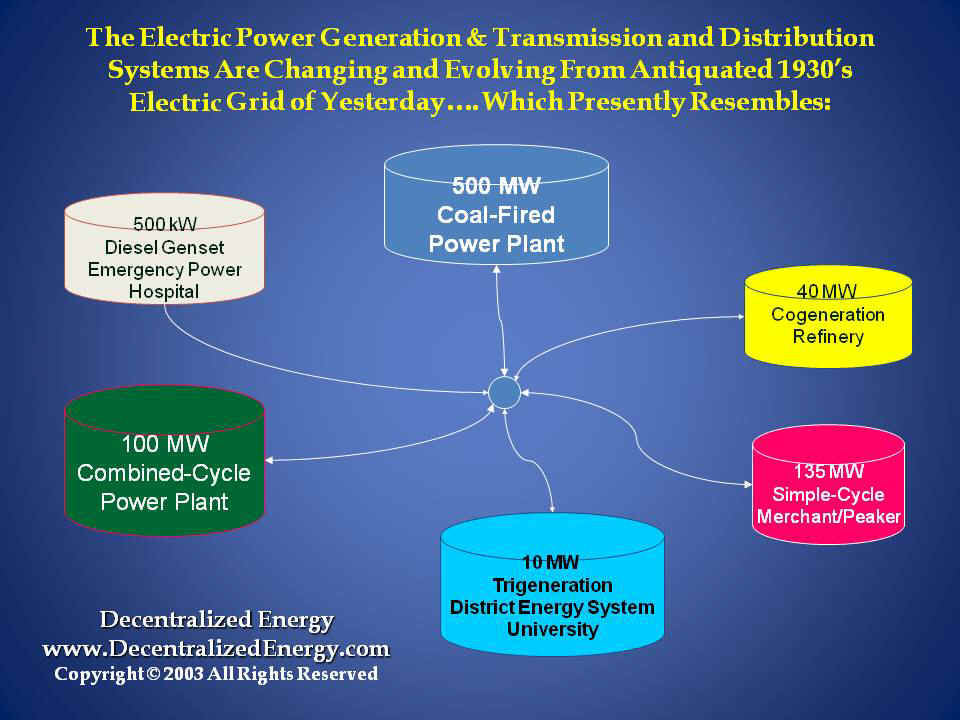
The electric power generation, transmission and distribution system (the electric "grid") is changing and evolving from the electric grid of the 19th and 20th centuries, which was inefficient, highly-polluting, very expensive and “dumb.”
The "old" way of generating and distributing
energy resembles this slide:
The electric grid of the 21st century (see slide below) will be Decentralized, Smart, Efficient and provide "carbon free energy" and “pollution free power” to customers who remain on the electric grid. The electric grid of the future will be comprised of both Onsite Power Generation plants and "utility scale power plants" that are fueled/powered with Biomass Gasification, Biomethane, Concentrating Solar Power, B100 Biodiesel, Distributed PV, EcoGeneration Systems, Geothermal Power Plants, Synthesis Gas, Rooftop PV, Solar Cogeneration, Solar Energy Systems, Solar Power Parks, Solar Trigeneration and Wind Power Generation - located at Residential, Commercial, Industrial and City/Municipal Locations.
Some customers will choose to
dis-connect from the
grid entirely.
(Electric grid represented by the small light blue circles in the slide below.)
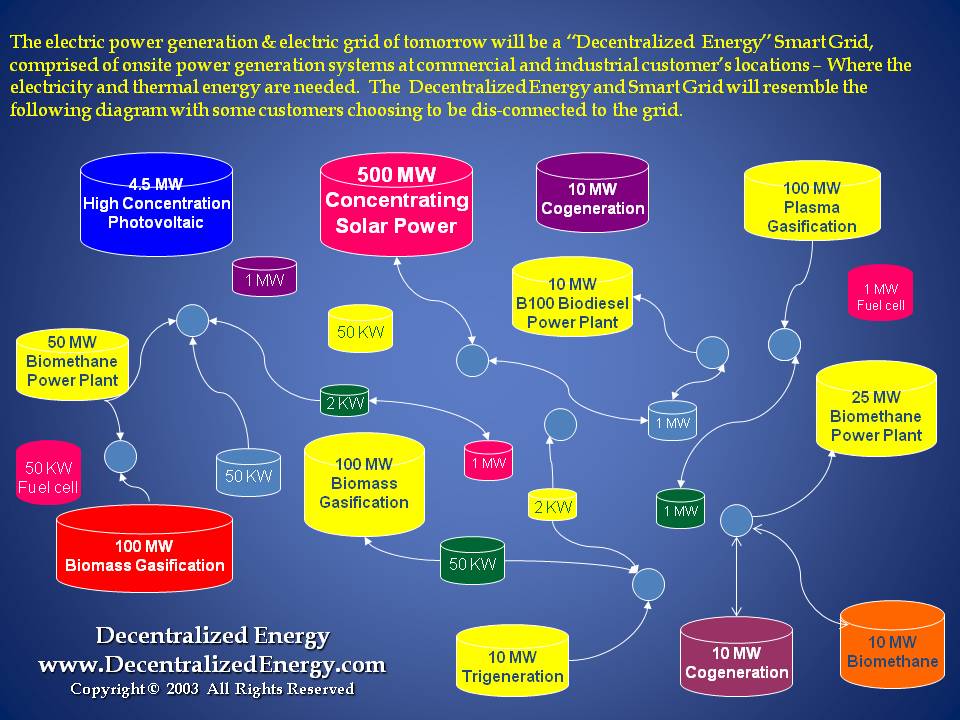
The transmission grid will be upgraded to a "Transmission Superhighway" with green electrons now being wheeled via "High Voltage Direct Current."
Typical "central" power plants and the electric utility companies that own them will either be shut-down, closed or go out of business due to one or more of the following: failed business model, inordinate expenses related to central power plants that are inefficient, excessive pollution/emissions, high costs, continued reliance on the use of fossil fuels to generate energy, and the failure to provide efficient, carbon free energy and pollution free power.
Carbon free energy and pollution free power reduces our dependence on foreign oil and makes us Energy Independent while reducing and eliminating Greenhouse Gas Emissions.
* Some of the above information from the Department of Energy website with permission.
____________________________________________________
Why the U.S. Needs A "Unified Smart Grid" or "Transmission Superhighway"
According to Monty Goodell, the Chairman and Founder of the Renewable Energy Institute, "our country desperately needs to upgrade its' national electric grid. The grid of today is a relic from the past, that is inefficient and costly. Originally built in the 1930's, it is costing our nation approximately $120 billion every year due to its' outdated and out-lived existence. The national power grid as designed and built in the 1930's does not have the efficiencies and capabilities to keep pace with the national power grid's demands of today."
"What we need" according to Mr. Goodell, is a "Unified Smart Grid" or what we prefer to call a "Transmission Superhighway."
A Transmission
Superhighway would be buried underground and "wheels" or transmits
the renewable power ("green electricity") from the wind farms of the
midwest, and solar farms of the southwest, and geothermal farms of the west, to
load centers throughout every corner of the U.S."
According to many estimates, the "Unified
Smart Grid" or "Transmission
Superhighway" could be built for about $400 billion. Through its'
increased efficiencies, savings and reliability improvements that it will
provide, the nation's new "unified smart grid" will be paid in full,
in less than 4 years.
____________________________________________________
Greenhouse Gas
Emissions
Linked to
the Loss of Polar Bears
Photo courtesy of Alaska Image Library. U.S.
Fish and Wildlife Service
About the Renewable Energy Institute,
Climate Science,
_______________________________________________________
Tax-payer Subsidies for Fossil Fuel & Nuclear Industries,
Peak Oil
& America's Clear and Present
Danger
Founder and Chairman
Renewable Energy Institute
The Renewable Energy Institute (REI) does not take a stand in the debate on global warming, and if there is global warming, is it "anthropogenic" or is it caused by the sun, or the sun's normal cycles. Or, if there is " climate change," is it "global cooling" caused by the water vapor in the atmosphere? The stand we take is that we need to invest in renewable energy technologies, producing clean, renewable energy that doesn't pollute the planet, and end America's addiction to crude oil from foreign countries where we now spend OVER $1 Billion/day, to buy the oil we need, and some of those suppliers (muslims in foreign countries) take our dollars and make bombs and bullets and send our boys back in body bags. We need to stop this, and put American's back to work, generating "green power and energy" right here at home.
At the Renewable Energy Institute, we are waiting for the "true" scientists who doing the real research, to provide us with the science and answers critically needed to formulate correct policy - and not the phony " scientists" who are following politically-motivated and profit-driven agendas of the United Nations and government leaders. These phony scientists are not interested in conducting real scientific research. Their very livelihoods are dependent on the government grants to fund their phony research that have pre-determined conclusions before and "research" is conducted.
Political-interference by governments, governmental agencies, and bureaucrats that hand out billions of tax-payers dollars to phony scientists to conduct "junk science" and research, expect the conclusions that supports anthropogenic global warming, or climate change.
When scientists conclude in their research that they find no evidence of anthropogenic climate change or global warming, they are summarily dismissed, and black-balled from their communities and colleagues, and never again receive funding or grants. Grants and funding by government bureaucrats with politically-driven agendas to "scientists" expecting their pre-determined results and conclusions supporting anthropogenic global warming must stop.
According to the International Energy Agency (IEA), in 2007
the solar industry received $198 million in subsidies.
the oil and natural gas industry collected $2.1 Billion in tax-payer subsidies.
the coal industry coal received $3.2 Billion in tax-payer subsidies.
And since 1960:
the nuclear industry has received nearly $70 billion in tax-payer incentives and tax-payer subsidies.
Taxpayers have bankrolled the oil and gas industry, and the coal industry for 100 years now, and the nuclear industry for 50 years, to keep these dirty fuels and energy "cheap." Take away the tax-payer incentives and tax dollars, and we believe the real cost of gasoline, would be similar to the gasoline cost in Europe - $7.00 - $8.00/gallon!
In the meantime, our U.S. Military is spending billions of tax-payer dollars each year protecting the Straits of Hormuz where much of the world's crude oil is produced and shipped through the straits' international shipping lanes. Each day, hundreds of "very large crude carriers" pass through the Straits of Hormuz carrying oil from OPEC and the Middle-East to the U.S. and many other countries.
Isn't it time we take some of the tax-payer dollars supporting the nuclear, coal and oil and gas industries, and start incentivizing clean, renewable energy technologies that don't pollute or harm the environment in any way? Isn't it time that America ends its reliance on non-sustainable energy sources and stop over $1 billion every day, to oil suppliers from foreign countries, and start putting this money in "solar on every rooftop?!?
Mercury Emissions from Coal Fired Power Plants Far More Harmful to the Planet and People than Greenhouse Gas Emissions
Regarding the harm being caused to our planet from energy use, far more harm is being done to the planet, as well as to people and plants and animals, particularly fish, from the mercury emissions from coal fired power plants than from the coal fired power plants' greenhouse gas emissions. We surmise that if any polar bears have died as a result of an environmental problem, it was more likely from the high levels of mercury in their food chain, than from greenhouse gas emissions.
The Renewable Energy Institute is supporting and advancing renewable energy technologies, as well as reducing and eliminating greenhouse gas emissions and the fossil-fuel problems related to America's oil addiction and ending our dependence on foreign oil. The renewable energy technologies we support are already deemed to be economic, viable and practical. Solutions such as Solar Trigeneration energy systems (see www.SolarTrigeneration.com for more information) for any kind of facility or building - office buildings, shopping centers, data centers, university campuses, etc.
Since 2003, a Solar Trigeneration energy system has been providing 100% of the power and energy for a 5,300 sq. ft. office building near downtown Los Angeles, and doing so without any connection to the electric grid, whether its 12 noon or 12 midnite!
The Renewable Energy Institute is also involved in research and advocacy of "Net Zero Energy" (see: www.NetZeroEnergy.com for more information) and "Net Zero Energy Buildings" (see: www.NetZeroEnergyBuildings.com for more information). Net Zero Energy Buildings generate as much (or more) energy than they use, and export their excess power to the grid, which we believe needs to be updated into a "Transmission Superhighway."
Climate Change, Global Warming or Global Cooling?
The past 10 years indicates the opposite of "global warming" has occurred - that the "Earths Fever" has and that global cooling has taken place.
Weather, on a daily basis, or even an annual basis, is not climate, and climate is not weather.
"Climate change" is always taking place, from one day to the next, and one week to the next, as well as one year to the next. The planet's climate is an ever-evolving, changing and dynamic process.
Again, researchers and scientists need to refrain from being political, and stay out of politics, and politicians need to stay out of the way of the scientists and researchers, and let them do their work. Politicians, government leaders and bureaucrats scientists need true and accurate data and climate research from scientists that do not have a political agenda.
In the meantime, as there may still be 30 years of research before there are conclusive answers concerning anthropogenic climate change, can we "risk" 30 years of our children and grand children's future, should there is a link between climate change and greenhouse gas emissions? Should we not err on the side of caution?
Hubbert's Peak Oil Predictions Now Proving True?
Marion King Hubbert was a geologist and scientist who worked at Shell Oil company's research lab in Houston, Texas. Hubbert made several important contributions to geology, geophysics and petroleum geology. Hubbert is most recognized for the "Hubbert Curve" and " Hubbert Peak Theory" which is now referred to as " Peak Oil.
Hubbert's life work determined that the world has a finite amount of petroleum that can be produced. (Similarly, there is a finite amount of coal.) Many scientists and engineers believe we have reached Hubbert's "peak oil" limit. Hubbert's espouses that when 50% of domestic crude oil production has been reached, that there will be such significant upward demand on prices of the limited supplies of oil production, that the U.S. economy will experience severe economic, social, and political turmoil.
Hubbert's Peak Oil predictions have proven to be true and this is validated as the U.S. in the early 1970's produced about 60% of its' oil demand and imported 40%. That equation has flipped since then, because our domestic oil production has been on the decline since 1970, so now, due to our declining domestic oil production, we have to import 60% of our oil supplies, to meet our country's oil/energy demands.
The Next Oil Shock Could be the "mother" of All Oil Shocks
How severe our economic calamity and next "oil shock" will depend upon a number of factors, including when this occurs, as well as the following:
1. the dependence of the individual country upon its own crude oil production to meet its energy needs and to subsidize consumer imports;
2. the rate of relative decline in crude oil production;
3. the degree of difficulty encountered in replacing missing energy inputs;
4.
the degree to which our country had prepared in advance for this inevitable geological
and economic calamity.
Examples of past "oil shocks" and the economic and political
calamities that followed:
United States: Our peak crude oil production of domestic oil occurred in
1970; the first "oil shock" and oil crisis followed in 1973 with the
Arab/OPEC Oil Embargo.
Iran: Their peak crude oil production occurred in 1974; They had their islamic revolution 1979 that overturned government and replaced it with radical islam.
Soviet
Union: Their peak crude oil production
was in 1989; what happened next?
Their country disintegrated and the collapse of the Soviet Union followed in 1991.
Indonesia: Their peak crude oil production was in 1991; their financial
and government crisis followed in 1997.
Iraq: Iraq's crude oil production was in 1989; they then invaded Kuwait (for their oil) in 1991.
Using Mr. Hubbert's predictions, that beginning around 2000 we would see peak (global) oil production, then, if the country's not weaning themselves off of their oil addiction, and had not begun making the switch to renewable energy, that the negative economic and political calamities would soon follow, including ever-increasing prices of energy that is from fossil fuels.
Now is the time to begin weaning ourselves off of fossil fuels and making the transition to and increasing the use of renewable energy. If you don't believe in climate change, or global warming, GREAT! Join us in the switch to renewable energy and a fossil-free economy!
_______________________________________________________
America's Clear and Present Danger"
America
Has INCREASED its' Dependence on Foreign
Sources of Energy by 50% Since 1973.
America is even more "addicted" to foreign oil today, than we were in 1973 - 1974 when OPEC, Saudi Arabia and other suppliers from the Middle-East stopped selling us their fossil fuels, and created a significant blow to our economy.
According to the CIA Fact Book, Every Day, the U.S.:
PRODUCES: 7,460,000 bbls of oil
CONSUMES:
20,800,000 bbls of oil
This Means that 65% of America's Energy Supplies are Now Imported from Suppliers from Foreign Countries.
Simply put, about 65% of the gasoline in your car's gas tank, comes from a foreign country.
EVERY day, the U.S. must IMPORT over 13 million bbls of oil from foreign countries and foreign suppliers to meet demand.
At
$80/barrel of oil, this also means that $1,040,000,000.00 American Dollars leave
our country, EVERY DAY, to foreign countries/suppliers of our fossil fuels, to
pay for the energy we need.
That's
$1 Billion EVERY day leaving our economy, and going to support a foreign
country's economy.
Talk
about our foreign trade deficit..... nearly $400 Billion each year, leaves our
country to pay for our oil addiction and the energy we need. To be exact,
that's $379,600,000,000.00 American Dollars.
This is NOT acceptable.
America needs to quickly transition to Energy Independence.
Renewable Energy is the Only Way America Can Achieve Energy Independence.
Millions of new and sustainable American jobs would be created here at home, if we would end our addiction to foreign fossil fuels, and quickly transition to an economy based on renewable energy and renewable fuels, produced here in the U.S.A.
The good news is that today, America already has all of the Renewable Energy Resources and Renewable Energy Technologies needed to make American Energy Independence a reality.
According to Monty Goodell, Founder and Chairman of the Renewable Energy Institute, "our increased dependence and reliance on foreign energy supplies represents a Clear and Present Danger to our national security, our economy, and the lives and livelihood of every American. Energy - including the energy we use from imported fossil fuels, is the very "lifeblood" of the American economy as it is for every industrialized country. An economy dies without it's lifeblood of energy. This Clear and Present Danger we face is far more serious than the problems related to greenhouse gas emissions. And while greenhouse gas emissions are very serious issue, in the long-term, pales in comparison to America's vital national security interests and America's economic stability in the short term. For this reason alone, America needs to transition away from its addiction to foreign energy supplies. And America's abundant renewable energy resources such as the energy we receive from the sun, and renewable energy technologies such as concentrated solar power (CSP) plants - can supply 100% of America's power requirements with a concentrating solar power plant measuring 75 miles by 75 miles, located in the Southwest U.S. By generating America's power from concentrating solar power plants, America resolves its' short-term Clear and Present Danger as it relates to importing its energy from foreign countries, and the long-term problems relating to greenhouse gas emissions."
Continuing, Mr. Goodell states that "too many Americans have forgotten what happened to us in 1973, when the Arabs and OPEC brought the United States economy to a screeching halt during the OPEC Oil Embargo. This happened because they (mainly the country of Saudi Arabia) disagreed with our foreign policy and is the reason why they "turned off the tap" of our need for their oil supplies. When Saudi Arabia and OPEC stopped the vital flow of oil to our country in 1973, they caused an "oil shock" that severely and negatively impacted our economy.
Mr. Goodell's question for us to ponder is, "do these countries who sell us 60% of our daily energy requirements, like us and our foreign policy, or might they leverage our addiction to their fossil fuels, and turn off the tap to make us adjust or revise our foreign policy?? Like any addict, America's foreign policy may be held hostage to its addiction, and in this case, our addiction to foreign oil, may over-ride our national interests."
Have
American's forgotten the gas shortages and long lines at
their gas stations to get
gas during the Arab Oil Embargo of 1973?
"Apparently so." Mr. Goodell states that "in 1973, America was 'addicted' and 'over the barrel' of foreign oil to the amount of 40%. Forty percent of our energy 'needs' in 1973 came from countries - many of which didn't like us then, and I'm afraid, many of them still don't. The difference between 1973 and today - is that today we receive 50% MORE foreign oil now than we did in 1973. And now we know about the problems relating to greenhouse gas emissions that we didn't know then. America needs to change course, and change course now, in terms of its' energy supplies and how we keep America's economy strong, without the threat of being held hostage to a middle-east tyrant or regime, that could once again, turn on us, and turn off our supply of foreign oil."
Remember ????
"Sadly," Monty Goodell continues, "most Americans have forgotten the long lines of people waiting in their cars
- lined up and waiting
for gasoline at their nearby gas station, with lines that were many blocks
long. And, after waiting 4-5 hours, many even waiting overnight in many places, to
finally take their turn to fill up their car with gasoline, only to find that
the gas station
had run out of gas."
"Let me Repeat.... That was 1973 when we imported 40% of our daily energy requirements in the form of crude oil from overseas, and from foreign countries - and many of these from countries that don't like us.
Today, over 35 years later, America has yet to learn the lesson. We cannot continue our reliance on energy from foreign countries that supply us with 60% of the crude oil that our refineries use as a feedstock for producing gasoline and diesel fuel for our cars and trucks comes from overseas.
America is "over the barrel" and it's not our barrel, but the barrels of oil that we are addicted by and owned by other countries. Why have we not learned the lessons we needed to learn in 1973 when we were cut-off from the vital energy supplies we need?
Countries like China, are growing rapidly, and have an insatiable need for crude oil. China, with their booming economy, is increasingly growing in its clout and control over international supplies of crude oil - whether they do this through their ability to buy as much oil as they need on a daily basis, or whether they simply but American drilling rigs, technology, and explore and produce oil and gas from their own fields. China, is buying large amounts of oil for their country, and causing upward pricing on declining supplies. What happens if Russia, with all of their oil and natural gas, along with China and Venezuela, with or without the help of OPEC, decided to NOT sell oil to us????
To be sure, greenhouse gas emissions are a problem, and to some, greenhouse gas emissions are also a Clear and Present Danger, but not to the extent that it presents an imminent Clear and Present Danger.
America's reliance for 60% of our energy "needs" coming from foreign suppliers is un-acceptable.
The "driver" to get America to begin reducing and eliminating fossil fuel use should be our nation's national security and the welfare and safety of its citizens. And this can all begin with developing and investing in our own renewable energy resources and renewable energy technologies, let's start by putting solar on every rooftop that has a clear and unobstructed view of the Southern sky. See www.RooftopPV.com or www.DistributedPV.com for more information. Let's create incentives begin with adopting a national "Feed In Tariff" as Germany did in 1990.
America,
we simply do NOT have the luxury of time on our hands. We need to end our
dependence and reliance on foreign fossil fuels, especially from countries that
don't like us! We need to rapidly begin expanding renewable energy
resources and renewable
energy technologies from our vast and abundant renewable energy resources,
such as; solar, solar energy systems, solar cogeneration, solar trigeneration,
"solar on every roof," waste to energy, waste to fuel, biomass
gasification, B100 Biodiesel, Biomethane, Synthesis Gas, geothermal, E100
Ethanol (from sugar cane and NOT from corn), and wind, where it makes economic
sense."
For more
information, call or email:

![]()
_____________________________________________________________
Are you doing your part to prevent Climate Change and End America's Reliance on Foreign Energy?
Our following EcoGeneration
technologies,
including our
Biomethane, B100
Biodiesel and Synthesis Gas Fuels
Generated from our "Waste to Fuel"
technologies are Carbon Free Energy
and Pollution Free Power
solutions that will:
* forever change the way energy is generated and used.
* eliminate or greatly reduce our customer's electric demand charges and electric expenses.
* slow, stop and eventually reverse climate change by reducing and then
eliminating anthropogenic greenhouse
gas emissions - of which carbon
dioxide emissions makes up 80% of all greenhouse
gas emissions.
* reduce and eventually eliminate the use of coal and other fossil fuels.
*
reduce the need for inefficient and expensive central power plants owned by
utility companies.
* promote energy independence.
* end America's dependence on oil from OPEC and other countries in the Middle-East, Venezuela and end our need for importing natural gas from Russia.
Anaerobic Digester
www.AnaerobicDigester.com
Anaerobic Digesters
www.AnaerobicDigesters.com
B100 Biodiesel
www.B100Biodiesel.com
Biomass
Gasification
www.BiomassGasification.com
Biomethane
www.Biomethane.com
Carbon
Dioxide Emissions
www.CarbonDioxideEmissions.com
Carbon Emissions
www.CarbonEmissions.com
Carbon Free Energy
www.CarbonFreeEnergy.com
Clean Power Generation
www.CleanPowerGeneration.com
Cogeneration
www.Cogeneration.net
Concentrating
Solar Power
www.ConcentratingSolarPower.com
Distributed
PV
www.DistributedPV.com
Distributed
Solar Generation
www.DistributedSolarGeneration.com
EcoGeneration
www.EcoGeneration.com
Greenhouse Gas Emissions
www.GreenhouseGasEmissions.com
Net
Zero Energy
www.NetZeroEnergy.com
Net
Zero Energy Building
www.NetZeroEnergyBuilding.com
Pollution
Free Power
www.PollutionFreePower.com
Rooftop
PV
www.RooftopPV.com
Solar Energy Systems
www.SolarEnergySystems.net
Solar Power Parks
www.SolarPowerParks.com
Solar Cogeneration
www.SolarCogeneration.com
Solar Trigeneration
www.SolarTrigeneration.com
Synthesis Gas
www.SynthesisGas.com
Trigeneration
www.Trigeneration.com
Waste Heat Recovery
www.WasteHeatRecovery.com
Waste to Energy
www.WasteToEnergy.net
Waste
To Fuel
www.WasteToFuel.com
Wind
Power Generation
www.WindPowerGeneration.com
Wind
Power Technologies
www.WindPowerTechnologies.com
________________________________________________________
We support the Renewable Energy Institute by donating a portion of our profits to the Renewable Energy Institute in their efforts to reduce fossil fuel use through renewable energy and their goals to end fossil fuel pollution by reducing/eliminating Carbon Emissions, Carbon Dioxide Emissions and Greenhouse Gas Emissions.
The Renewable Energy Institute is "Changing The Way The World
Makes and Uses Energy by Providing Research & Development, Funding and Resources That Creates Sustainable Energy via 'Carbon Free Energy' and 'Pollution Free Power' Through Expanding the use of Renewable Energy Technologies."
![]()
www.RenewableEnergyInstitute.org
Email: info(@)Renewable Energy Institute (.)org
The information contained on this site is
copyright protected and
cannot be
reproduced in any form or manner without our consent.
Waste To
Fuel
www.WasteToFuel.com
Renewable Energy Institute
Copyright
© 2002
All Rights Reserved